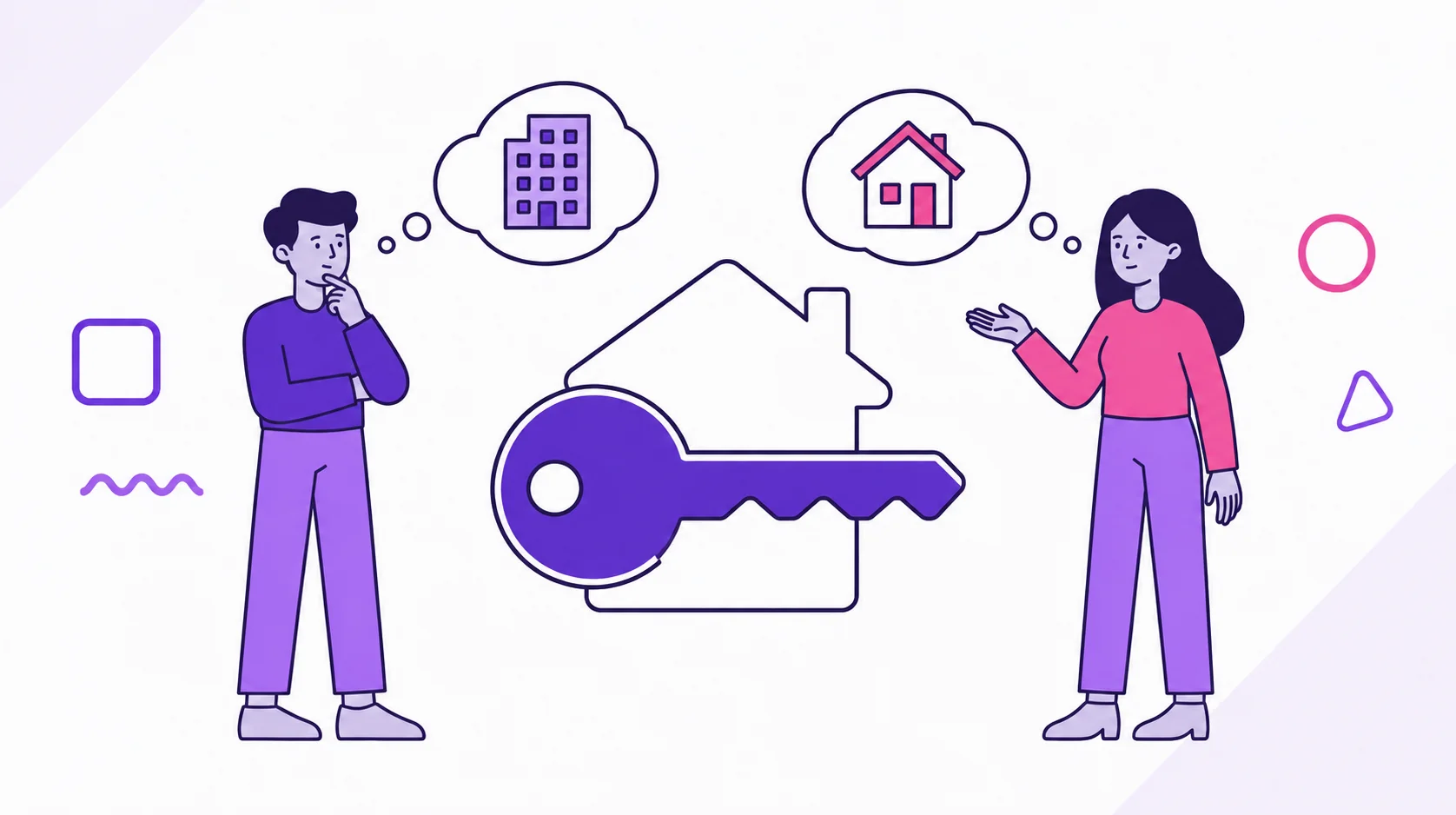
Renting or buying a home with your partner is a decision about time, cash, and how much risk your monthly life can carry. Renting protects flexibility. Buying can build ownership, but it also puts more money and responsibility on the line upfront.
There is no universal winner. The rent-or-buy decision is not rent versus a mortgage payment; it is one complete housing budget versus another.
This is educational information, not individualized mortgage, financial, tax, legal, or real-estate advice. Property, tenancy, tax, and ownership rules can vary by state, city, lender, and contract.
Rent or buy a home: start with how long you expect to stay
Renting often fits when a move, job change, or neighborhood test is still possible. Buying can fit when both of you expect to stay, the cash to close does not drain your emergency savings, and the total monthly cost works without relying on a perfect month.
| Decision point | Renting | Buying |
|---|---|---|
| Time horizon | Easier to change cities, neighborhoods, or home size | Usually works better with a longer, more stable stay |
| Upfront cash | Deposit, first rent, moving, utility setup, and basics | Down payment, cash to close, moving, repairs, and a reserve afterward |
| Monthly cost | Rent, renters insurance, utilities, parking, and fees | Principal and interest, taxes, insurance, HOA or condo fees, utilities, and maintenance |
| Control | The lease and landlord set some limits | More control, plus responsibility for repair and upkeep |
| Risk as partners | Lower long-term commitment, but rent can rise | A larger shared commitment if income or repair costs change |
Buying is not automatically better because it can build equity. Renting is not automatically wasted money because flexibility has value. When you rent or buy a home with a partner, the better route is the one that fits the life you actually expect to live.
Housing rates and rent benchmarks are useful context, not an answer
Freddie Mac reported that the average 30-year fixed mortgage rate was 6.49% on July 9, 2026 in its Primary Mortgage Market Survey. Your rate can be different, but the weekly figure is a reminder to test a lender quote instead of assuming an old payment estimate still applies.
For rent, HUD’s FY 2026 Fair Market Rent documentation provides location-based benchmarks and explains how the figures are developed. It is not a listing for your exact apartment, but it can keep a local search from drifting into a number with no reference point.
Use both sources to start a local worksheet. They do not tell you what you can comfortably afford, and neither one replaces the actual lease terms or loan estimate in front of you. Whether you rent or buy a home, the local numbers need to work with your own cash and plans.
Compare two full housing budgets, not rent with principal and interest
Put the same level of detail on each side. A mortgage payment alone can look manageable while taxes, insurance, HOA fees, and repairs are still outside the picture.
| If you rent | If you buy |
|---|---|
| Rent and lease renewal terms | Principal and interest from the lender quote |
| Renters insurance, utilities, parking, and fees | Property taxes, homeowners insurance, utilities, HOA or condo fees |
| Application fee, deposit, moving, and basic setup | Down payment, closing costs, appraisal, moving, and immediate repairs |
| Cash buffer for a move or rent increase | Cash buffer for maintenance or an income drop |
If you already rent, the left side changes at renewal. Check the proposed rent increase together before comparing the new price with a mortgage payment.
The CFPB’s Loan Estimate guide is a good document to read together before you celebrate approval. It puts the estimated loan terms, closing costs, and cash to close in one place, which makes lender quotes easier to compare.
A simple example before you start touring homes
Example: say a $350,000 home and a 20% down payment are your planning assumptions. That down payment alone is $70,000. It is not a promise about what your lender will require; it is a way to stop treating every dollar saved as money available for the home.
| Layer | Question for both partners |
|---|---|
| Cash to close | What does the Loan Estimate show after deposits, credits, and closing costs? |
| Remaining savings | What stays available after moving day? |
| Normal month | Does the all-in ownership cost leave room for food, transportation, debt, goals, and ordinary life? |
| Stress month | What changes if one income drops or a repair arrives early? |
If the answer leaves no buffer, renting for another lease can be a deliberate move, not a failure to buy. If you plan to rent or buy a home, the cash, time horizon, and monthly budget all need to hold up before you start shopping. A rent or buy decision is strongest when neither partner has to pretend the missing buffer will not matter.
When renting may protect the relationship more
Renting can be the calmer option when either of you may relocate, when you are still learning what area and home size work, or when the down payment would consume the money that protects you from an emergency.
You do not need a flawless plan to move forward. You need a plan that does not make one partner carry all the administrative worry or turn every unexpected bill into a fight. If renting is the route, the money checklist for renting your first apartment together walks through deposits, income screening, and moving costs step by step.
When buying may make more sense
Buying may be worth pursuing when you expect to stay, have cash beyond the transaction, and can carry the all-in monthly number without depending on overtime, bonuses, or a second perfect income.
Before you fall in love with a listing, agree on a ceiling that includes the things a lender approval does not settle: the post-move routine, maintenance, shared goals, and the reserve you both want to keep.
Five agreements to make before you choose
- Your likely time horizon. Talk about work, family plans, school, and the chance of moving.
- An all-in monthly ceiling. Include housing, bills, goals, and normal life, not only the mortgage payment.
- How you split cash and recurring costs. An even split works for some partners; a proportional split may be fairer when income differs.
- The savings floor. Name the amount that stays liquid after the move or closing.
- Ownership and exit terms. State property and relationship law vary. Get qualified legal and real-estate advice before you rely on an informal agreement.
Frequently asked questions
How do partners decide whether to rent or buy a home in 2026?
Neither is automatically better. Renting can protect flexibility and cash. Buying can fit a longer stay with enough savings and an all-in payment that works in a stress month. Compare your local lease, Loan Estimate, and shared time horizon instead of relying on a headline rate.
Why should we not compare rent only with the mortgage payment?
Homeownership also includes property taxes, insurance, HOA or condo fees, maintenance, closing costs, and cash reserves. Renting includes insurance, utilities, fees, and moving costs. A fair decision compares complete budgets on both sides.
How much should partners put down on a home?
There is no single right percentage. Loan type, lender rules, credit, home price, and location all matter. Use a planning example to separate down payment from cash to close and emergency savings, then compare actual Loan Estimates before you commit.
Should both partners be on the deed and mortgage?
That is a legal and financial decision, not a default setting. It can affect ownership, responsibility, credit, taxes, and what happens if the relationship or payment ability changes. Ask qualified local professionals before you sign.
Turn the decision into a shared plan
If you need to build the cash first, read moving in together: the upfront apartment fund. Whether you rent or buy a home, it separates the move-in or closing target from the emergency money you still need after the keys.
In dividi, you can create a goal in the shared space with a target amount and an optional target date. Bills linked to that goal can show contributions, while the Joint Account splits shared bills according to the percentages you agree on. That gives both partners one place to see the plan before a listing turns into a commitment.
To organize the plan, download dividi. The plans page explains the available features and limits.